Most people picture a bullet traveling in a roughly straight line, maybe dipping a little at the very end of its flight. That picture is wrong.
A bullet starts dropping the instant it leaves the barrel, and the downward curve accelerates the entire way out. That gap between intuition and physics is exactly where missed shots live.
Gravity Doesn't Wait
Let's clear up the biggest myth in ballistics: muzzle velocity does not defy gravity.
The moment a bullet exits the muzzle, two independent forces act on it at the same time. Forward momentum carries it downrange. Gravity pulls it toward the earth at 32.2 feet per second squared, immediately, without delay. There is no grace period where the bullet flies flat.
A classic physics demonstration makes the point cleanly: fire a bullet perfectly level, and drop an identical bullet from the same height at the same instant, and both hit the ground at the same time. Gravity doesn't care how fast the bullet is moving forward. (In practice, your barrel is tilted slightly upward so the trajectory intersects your line of sight at your zero distance. More on that in a moment.)
The Curve Isn't Uniform
Here is the insight that catches most shooters off guard: bullet drop does not scale linearly with distance.
If your bullet drops 1.5 inches at 100 yards, you might expect 3 inches at 200 yards. But that's not how it works. At 200 yards that same bullet might be 7 inches low. By 500 yards, with a typical factory load, the bullet has dropped roughly 48 inches: about the height of the muzzle from a standing position.
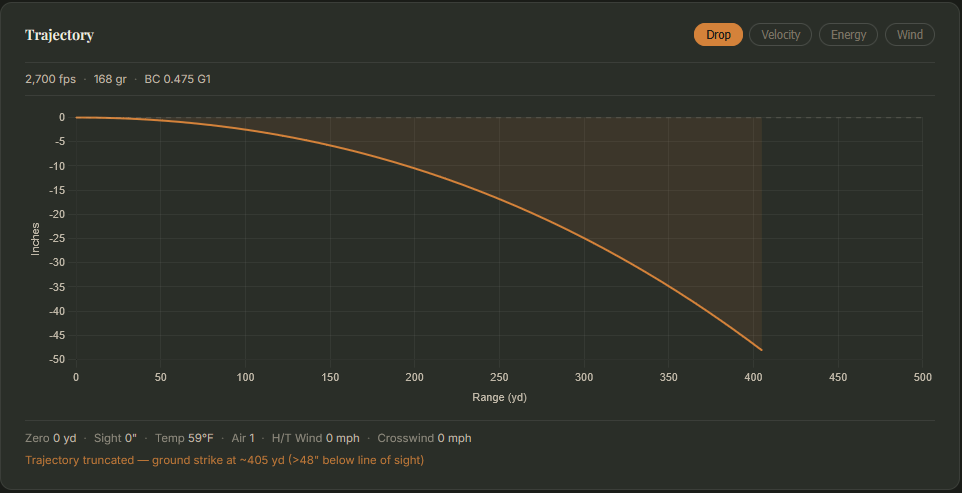
Drop from a level barrel: the curve accelerates as the bullet slows. Ground strike at ~405 yards, 48 inches below the line of departure.
The reason is air resistance. As the bullet flies, drag constantly bleeds off its forward velocity. Because it takes longer to travel the second 100 yards than the first, gravity has more time to act during that second stretch. The further the bullet travels, the slower it moves, and the more sharply the trajectory curves downward. This is why precise distance estimation matters so much in the field.
Your Zero Doesn't Eliminate the Curve
If bullets drop from the moment they leave the barrel, how do we hit anything? The answer is in how you zero the rifle.
When you zero, you aren't making the bullet fly straight. You're tilting the barrel slightly upward relative to your scope. Think of your line of sight as a straight horizontal beam. The bullet starts below that beam at the muzzle, arcs up through it, reaches its highest point, then curves back down and crosses your line of sight a second time at your zero distance.
The curve always exists. Zeroing just picks the distance where it intersects your aim.
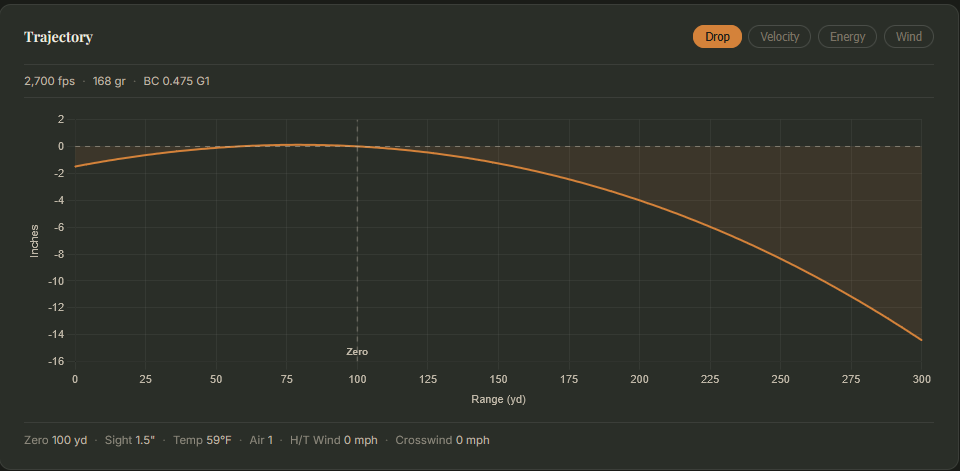
A 100-yard zero: the bullet crosses the line of sight twice. The curve still exists. Zeroing picks the distance where it intersects your aim.
Wind Adds a Second Problem
Gravity pulls the bullet down. Wind pushes it sideways. And like drop, wind drift is not linear.
At short ranges a light crosswind barely registers, because the bullet spends so little time in the air. At distance, that same wind has much more time to work, and the drift compounds as the bullet slows. The two forces, vertical and horizontal, operate independently, and neither one is forgiving at extended range.
How well a bullet resists wind drift comes down largely to its shape and weight. That's what ballistic coefficient measures. If that concept is new to you, What Is Ballistic Coefficient? covers it in plain language.
Every Load Has Its Own Curve
There is no universal trajectory. Every combination of rifle, cartridge, and conditions produces a unique flight path.
A 6.5 Creedmoor pushing a sleek 140-grain bullet at around 2,700 fps will have a much shallower, more forgiving curve than a heavy, slow-moving .45-70 Government stepping out at around 1,850 fps. Change the altitude, temperature, or bullet weight and the math changes with it. The only way to know what your specific load does at distance is to calculate it.
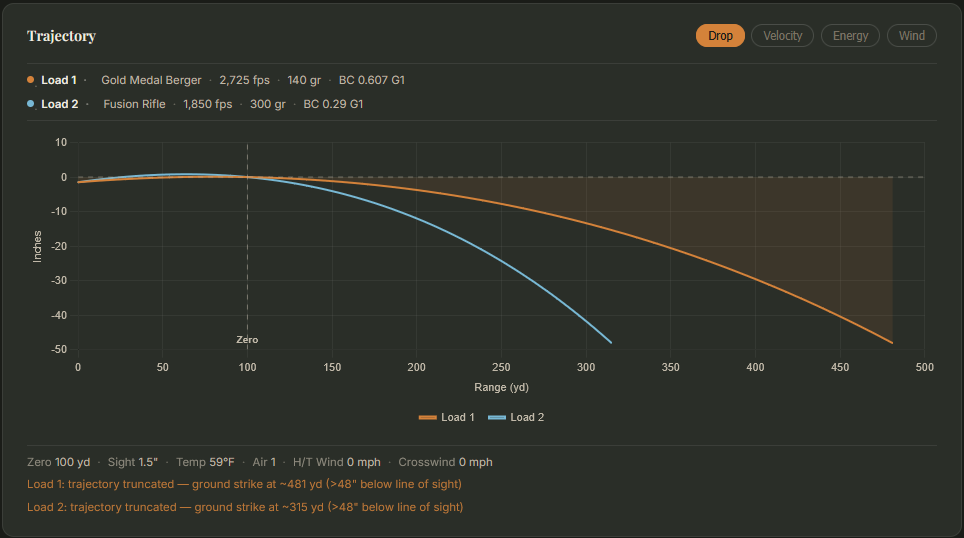
Same zero, two very different curves. The faster 6.5 Creedmoor load (orange) stays flatter significantly longer than the heavy .45-70 Government load (blue).
See Your Load's Trajectory
Understanding trajectory starts with replacing assumption with data. Plug your load into the BSL ballistics calculator and watch the curve take shape. See where your bullet is at 200 yards, at 300, at 400. You may be surprised how much it has moved before it gets there.
Once you've run it, How to Read a Ballistics Chart walks through what the graph is actually telling you and how to use that information in the field.