Picture two bullets leaving two rifles at the same instant. Same caliber. Same weight. Same muzzle velocity. By every number on the box, they look identical.
Now watch them travel five hundred yards downrange.
One arrives noticeably lower, having dropped more along the way, and pushed further sideways by the same crosswind. The other holds its line. Same starting conditions, two different stories, and the difference between them has a name.
That difference is ballistic coefficient.
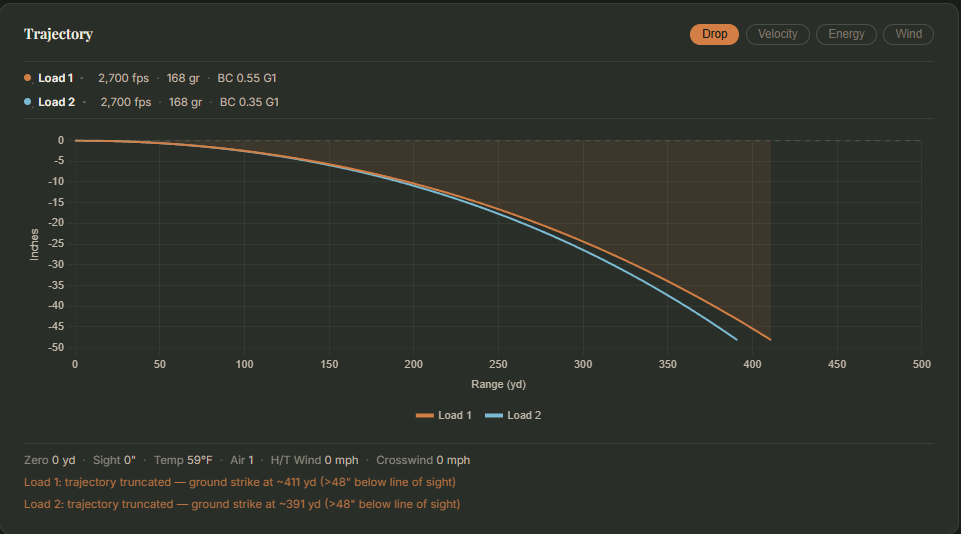
Drop comparison: same bullet weight and muzzle velocity, two ballistic coefficients. Zero set at muzzle to isolate BC's effect.
The Short Version
Ballistic coefficient, almost always shortened to BC, is a measure of how well a bullet overcomes air resistance as it flies.
A bullet with a high BC slices through the air efficiently. It holds onto its velocity, drops less over distance, and gets shoved around less by wind. A bullet with a low BC bleeds speed faster, falls away sooner, and drifts more.
That's the whole idea. Everything else is detail.
The reason BC matters is that air is not a gentle thing to a bullet. From the moment it leaves the muzzle, the bullet is fighting drag, and drag wins a little more with every yard. BC is simply the number that tells you how good your particular bullet is at that fight.
Why It's a Slippery Number (and Why That's Okay)
Most rifle specs describe something you can picture. Weight is weight. Muzzle velocity is how fast it's going when it leaves the barrel. You can hold those in your head.
BC is harder, because it isn't a physical thing you can point to. It's a ratio: a comparison between your bullet and an imaginary standard bullet. The number answers the question, "compared to a known reference shape, how well does this bullet cut through the air?"
You don't need to feel the math to use BC well. You only need one instinct: higher BC means the bullet fights air better. A .550 holds its speed and resists wind better than a .350 of the same weight. That instinct alone will serve you for the vast majority of shooting decisions.
What Actually Drives BC
Two things mostly determine a bullet's ballistic coefficient.
The first is how heavy it is for its diameter. A long, dense bullet packed into a narrow caliber carries a lot of momentum behind a small front-facing area, so air has a harder time slowing it down. A short, stubby bullet of the same caliber gives the air more leverage.
The second is shape. A long, sleek, pointed bullet with a tapered tail (a "boat-tail") parts the air far more cleanly than a flat-based bullet with a blunt nose. This is why modern long-range bullets all start to look the same: there's an aerodynamically ideal shape, and it's long, pointed, and streamlined at both ends.
Put simply, a bullet that is heavy for its width and shaped to slip through air will have a high BC. That's the recipe.
The One Catch: A BC Is Meaningless on Its Own
Here is the part that trips up almost everyone, and it's worth slowing down for.
Because BC is a comparison against a standard reference shape, the standard you compare against changes what the number means. There are two reference shapes you'll run into, and you cannot mix them up.
G1 is the old standard. Its reference projectile is short, flat-based, with a blunt round nose. Picture a stubby vintage artillery shell. G1 became the industry default mostly by momentum: it's what everyone published, so it's what everyone kept publishing.
G7 describes a long, sleek, pointed boat-tail: essentially the shape of a modern match or long-range hunting bullet.
This matters because the comparison is only trustworthy when the reference shape actually resembles your bullet. A modern streamlined bullet looks nothing like the dumpy G1 standard, so forcing its drag onto the G1 model produces a number that wobbles depending on how fast the bullet is going. That's why you'll sometimes see a manufacturer publish several G1 figures for a single bullet across different velocity ranges. They're patching a model that doesn't quite fit. A G7 figure for that same sleek bullet stays far steadier across its flight, which makes it the more honest number for long-distance work.
And the trap that catches newcomers: for the same bullet, the G1 number is always bigger than the G7 number, often by roughly double. A bullet might be listed as G1 0.500 and G7 0.250. Bigger looks better, so it's tempting to grab the larger figure and compare it against another brand's number. But if one is G1 and the other is G7, you're comparing apples to oranges.
The rule that keeps you safe: only compare BCs measured the same way. G1 to G1, or G7 to G7. Never across the two.
One practical note from building out our own cartridge data: you'll find G1 published on nearly everything, while G7 tends to show up only on premium, performance, and long-range lines. So if a manufacturer bothered to publish a G7 figure, take it as a quiet signal that the bullet was designed with distance in mind.
(The deeper story of why the G1 number drifts with velocity is worth its own article down the road. For now, the takeaway is enough: a BC needs its model attached, and you don't cross-compare.)
What Ballistic Coefficient Is Not
BC is useful, but it gets oversold. A few things it does not mean:
- It is not accuracy. A high-BC bullet that your rifle doesn't shoot well will still group poorly. BC governs how the bullet behaves in flight, not how consistently it leaves the barrel.
- It does not make a bullet "better." A high BC is an advantage at distance and in wind. At woods ranges inside a hundred yards, it barely registers. The right bullet is the one suited to the job, not the one with the biggest number.
- It is not a guarantee. Real-world flight is shaped by your specific rifle, your conditions, the air on that day, and a dozen other factors. BC is a strong predictor, not a promise.
Where to Find a Bullet's BC
You don't calculate BC yourself. The bullet maker measures and publishes it, and you'll find it:
- On the ammunition box or bullet packaging
- On the manufacturer's website, in the product specs
- In reloading and ballistics references
When you find it, note which model it's quoted in, looking for a "G1" or "G7" label nearby. If only one is listed, it's almost certainly G1. Write that down alongside the number, because the model is part of the number.
As a rough sense of what's normal: most bullets you'll encounter fall between about 0.1 and 0.7 on the G1 scale, so a number in that neighborhood means you're reading the right field. Some large, heavy calibers (a .50 BMG, for instance) can exceed 1.0, and that's perfectly legitimate. What you'll never see is a zero or a negative number; if you've landed on one of those, you're looking at the wrong figure.
Why It Matters Out in the Field
For a lot of everyday shooting, BC sits quietly in the background. Inside a hundred yards, even a modest bullet hasn't had time or distance for air resistance to matter much.
It starts to matter as range opens up. At longer distances, a higher-BC bullet drops less and drifts less, which means less guesswork and more margin when conditions aren't perfect. For the hunter trying to place a clean, ethical shot at distance, or the target shooter chasing consistency across a long string, that margin is the whole point.
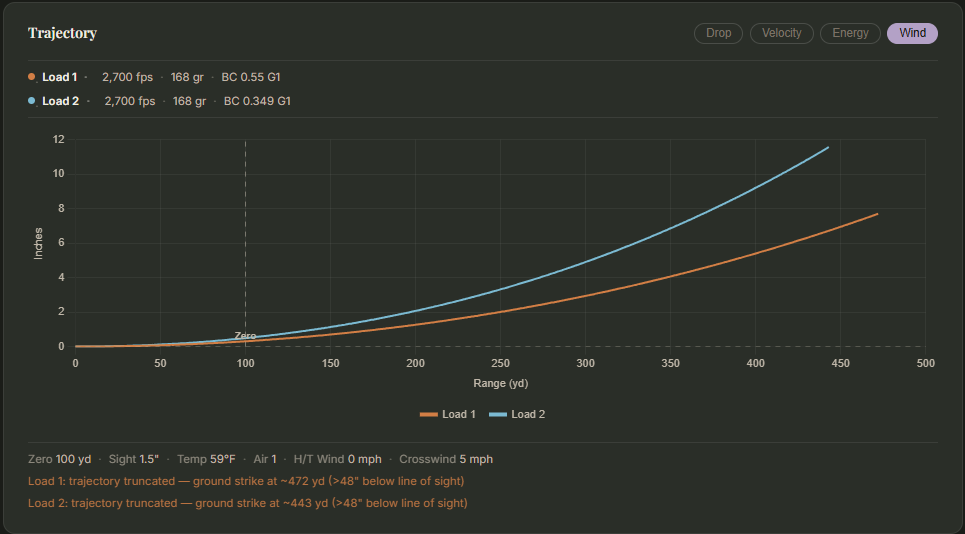 Wind drift comparison: same inputs, 5 mph crosswind. The lower-BC load gives the wind more to work with.
BC won't make you a better shot. But understanding it helps you choose a bullet that's working with you instead of against you, and that's where good decisions start.
Wind drift comparison: same inputs, 5 mph crosswind. The lower-BC load gives the wind more to work with.
BC won't make you a better shot. But understanding it helps you choose a bullet that's working with you instead of against you, and that's where good decisions start.
Put It Into Practice
The best way to make BC concrete is to watch it work. Take the actual BC of a bullet you shoot, drop it into the BSL ballistics calculator, and see how the trajectory changes. Then try a higher or lower number and watch the drop and drift respond. A few minutes of that does more than any explanation, including this one.